Of course. This is an excellent and specific topic in rubber manufacturing. Let's break down the Double-Roll Rubber Sheet Calender in detail.
What is a Double-Roll Rubber Sheet Calender?
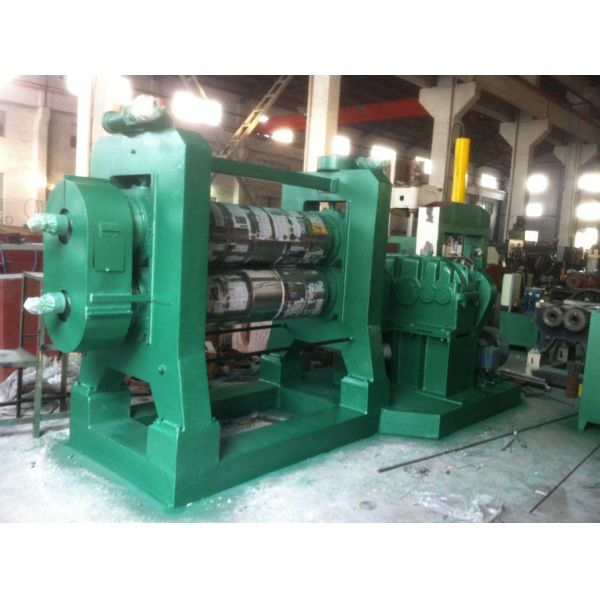
At its core, a double-roll calender is a machine used in the rubber and plastics industries to produce a continuous sheet of material with a uniform, precise thickness. It consists of two massive, precisely machined, counter-rotating rolls placed horizontally.
The raw, mixed rubber compound (which is thick, irregular, and dough-like) is fed into the "nip"—the gap between the two rolls. The immense pressure and shear force generated in the nip plasticize the rubber and squeeze it out into a smooth, continuous sheet.
Key Components
-
Rolls (Bowls): The heart of the machine. Typically made from chilled cast iron with a hard, smooth surface. They are often cored to allow for internal circulation of steam or water for precise temperature control.
-
Frame: A massive, robust structure that houses the rolls and withstands the tremendous forces generated during operation.
-
Nip Adjustment Mechanism: A sophisticated system (usually hydraulic or electromechanical) to precisely set and control the gap between the two rolls. This gap directly determines the final sheet thickness.
-
Drive System: A powerful motor and gearbox arrangement that rotates the rolls at a controlled, synchronized speed.
-
Auxiliary Equipment:
-
Feed Conveyor/Belt: To bring the rubber compound to the calender.
-
Stock Blender: A separate mill that pre-warms and homogenizes the rubber batch for consistent feeding.
-
Take-off Conveyor/Cooling Train: A series of rollers that carry the hot sheet away from the calender and through cooling baths or sprays.
-
Wind-up Unit: A motorized shaft that collects the cooled, finished sheet into a roll.
-
Web Guides: Ensure the sheet runs straight through the line.
How It Works: The Process Step-by-Step
-
Preparation: The mixed rubber compound is first passed through a stock blender or a two-roll mill to warm it up, make it more pliable, and ensure a consistent feed.
-
Feeding: The warm rubber is fed onto the conveyor and introduced into the nip of the calender.
-
Calendering (Sheeting): As the rolls rotate, the rubber is drawn into the nip. The combination of:
-
Pressure: Squeezes the rubber to the desired thickness.
-
Shear: Helps in final homogenization and de-aeration.
-
Heat: The heated rolls keep the rubber in a plastic state, allowing it to flow smoothly.
-
Take-off: The emerging sheet is cleanly stripped from the calender roll by the take-off conveyor. This is a critical step to prevent the sheet from sticking to the roll.
-
Cooling and Finishing: The hot sheet is passed over a series of cooling drums or through a cooling bath to set its dimensions and prevent sticking when wound up.
-
Winding: The cooled sheet is finally wound into a large roll for storage, transport, or the next processing step (e.g., cutting, molding).
Advantages and Disadvantages
| Advantages | Disadvantages |
| High Production Speed: Continuous process ideal for large volumes. | Limited Precision: Not as precise as a 4-roll calender for very thin or tight-tolerance sheets. |
| Good Surface Finish: Produces a smooth, uniform surface. | Sheet Crown Effect: The rolls can bend slightly under high pressure, causing the center of the sheet to be thicker than the edges (requires crown correction). |
| Simplicity & Lower Cost: Mechanically simpler and less expensive to purchase and maintain than 3-roll or 4-roll calenders. | Less Versatile: Primarily for simple sheeting. Cannot apply rubber directly to fabric (skim coating) like a 3-roll or 4-roll calender can. |
Comparison with Other Calender Types
-
vs. Two-Roll Mill: A two-roll mill also has two rolls, but its primary purpose is mixing, blending, and warming the rubber. The rolls typically run at different speeds (friction ratio) to create high shear. A calender's rolls usually run at the same speed (friction can be applied, but it's for a different purpose) and are designed for precision sheeting.
-
vs. Three-Roll Calender: A 3-roll calender (often in an inverted "L" or vertical configuration) allows for more passes and better control, producing a more refined sheet with improved gauge uniformity.
-
vs. Four-Roll Calender: The most advanced type. Configurations like "S" or "Z" rolls allow the rubber to pass through multiple nips without being bent, enabling the production of extremely precise sheets and the application of rubber to fabric (coating). They are the standard for tire cord and technical fabric coating.
Common Applications
Double-roll calenders are perfectly suited for manufacturing:
Key Operational Considerations
-
Temperature Control: Critical for consistency. Too hot, and the rubber will stick; too cold, and it won't flow properly.
-
Nip Adjustment: Must be precise and parallel across the entire roll width.
-
Roll Bending (Crowning): Compensating for roll deflection is essential to achieve a sheet with uniform thickness from edge to edge. Modern calenders often have roll bending systems that apply counter-forces to keep the rolls straight.
-
Bank Control: The amount of rubber fed into the nip (the "bank") must be controlled. Too large a bank can cause overheating; too small can lead to an incomplete sheet.
In summary, the double-roll rubber sheet calender is a workhorse machine for producing consistent, high-quality rubber sheet in a continuous, efficient process. While not as versatile or precise as more complex calenders, its simplicity, robustness, and cost-effectiveness make it a fundamental piece of equipment in many rubber factories.